A Jet (Lag) Induced Exercise in Binomial Probability
The mathematical thrill in particle physics of correcting your Monte Carlo simulation efficiencies to match what’s actually measured in data is rarely documented in popular science media, probably with good reason. But as I’m awake at 5am with jet lag I’ve made it my mission to write something to help insomniacs everywhere get back to sleep.
Imagine you have an algorithm to identify a physics process in your detector. For sake of argument let’s say this algorithm identifies jets containing b hadrons from those which don’t. Your simulation suggests that the probability to successfully identify the so-called b-jet is 50%. Now let’s suppose this simulation is a sample of 1000 events each containing exactly 3 b-jets, in how many of those events would you expect your algorithm identify all three jets? Only two of the three? One of the three? None of them? Fortunately this is a simple exercise in binomial probability with N=3 and p=0.5; using the binomial formula (fun exercise for the reader) we calculate:
- Events with 3 b-jets identified = 125
- Events with 2 b-jets identified = 375
- Events with 1 b-jet identified = 375
- Events with no b-jets identified = 125
Nice and symmetric. I probably want to measure a quantity something like: events with at least one b-jet identified. The simulation tells me I expect to see 875 such events in data. If alternatively my measurement was counting the number of b-jets identified then the prediction of the simulation is (3*125)+(2*375)+(1*375)+(0*125)=1500 b-jets. Not surprising for an algorithm efficiency of 50% in a simulation of 3000 b-jets!
But then a complication. Someone using a pure sample of b-jets in data from top quark decays has measured the actually efficiency of the algorithm to identify b-jets in data to be 60+/-10%, not the same as the simulation: the prediction is wrong. So what we now need is a simple way to correct the simulation so that it correctly predicts the number of b-jets while keeping other properties of the simulation the same: 1000 events and 3000 b-jets in total.
Fortunately binomial theory makes this simple. We want to correct the efficiency to p=0.6+/-0.1 (and corresponding inefficiency to q=(1-p)=0.4-/+0.1). Note that the change in the inefficiency is completely anti-correlated with the change in the efficiency to keep the total probability one. For every p in the binomial formula we need to add a factor of 1.2+/-0.2 and for every q a factor 0.8-/+0.2 so we get an event weight depending on the number of b-jets identified in the original simulation:
- Weight for events with 3 b-jets identified = 1.2*1.2*1.2 = 1.728
- Weight for events with 2 b-jets identified = 1.2*1.2*0.8 = 1.152
- Weight for events with 1 b-jet identified = 1.2*0.8*0.8 = 0.768
- Weight for events with no b-jets identified = 0.8*0.8*0.8 = 0.512
Which gives us a new prediction for what we expect in data:
- Events with 3 b-jets identified = 125*1.728 = 216
- Events with 2 b-jets identified = 375*1.152 = 432
- Events with 1 b-jet identified = 375*0.768 = 288
- Events with no b-jets identified = 125*0.512 = 64
Still 1000 events with 3 b-jets in total! You can also cross-check that these are exactly the numbers expected from the binomial formula with N=3 and p=0.6. We now revise our simulation based prediction for events with at least one b-jet identified to 936 and for counting the number of b-jets identified to 1800 – or 0.6*3000 as we would expect, the system works 🙂
Very eager readers are welcome to propagate the uncertainty on the efficiency correction too… Which coincidentally is exactly what I’ll be doing today with the ATLAS simulation and b-tagging algorithms now that it’s 7am in Berkeley and a more reasonable time to go to work.
Is it a Higgs?
Here’s a quick relatively non-technical FAQ on the Higgs results from yesterday. If you have another question send me a tweet or leave a comment below and I’ll answer it if I get time.
Has the Higgs been discovered?
Maybe! Usually ‘the’ Higgs refers to the Standard Model Higgs but many other theories (e.g., Supersymmetry) have a Higgs sector. The searches at ATLAS and CMS are designed to look for the Standard Model Higgs. This means we can get a very good idea of how consistent the data are with what we expect the Standard Model to look like. The current results are largely consistent with these expectations.
Have we reached the 5 sigma benchmark for observation?
Yes and no. The Standard Model Higgs, once its mass is known, has well predicted decay rates. At the LHC we reconstruct 5 decay channels:
- Higgs decays to 2 photons
- Higgs decays to 4 charged leptons via ZZ(*)
- Higgs decays to 2 charged leptons and 2 neutrinos via WW(*)
- Higgs decays to 2 tau leptons
- Higgs decays to a b quark and an anti-b quark
None of these individual channels have been measured at the 5 sigma level, instead when statistically combining the data from each decay channel the individual – smaller – excesses over background reinforce each other and push the combined significance over the 5 sigma level. The goal in the next months will be to see if the 5 sigma measurement can be made in each decay channel. The current measurement is mainly dominated by the 2 photon channel followed by the ZZ channel.
Is there any inconsistency with a Standard Model Higgs?
Possibly. There are not enough data to draw firm conclusions but both experiments see a slightly higher than expected rate in the 2 photon decay channel. Perhaps more interesting and in need of further investigation is the CMS result for the 2 tau lepton decay channel. Currently this updated result comes very close to excluding a 125GeV Standard Model Higgs at the 95% confidence level. ATLAS does not have an updated result yet but if it reinforces the CMS result this would be a very compelling indication that we’re not dealing with a Standard Model Higgs. The next few months could be very interesting!
What can we say about the new particle?
It decays to 2 photons and 4 charged leptons via ZZ and possibly to 2 charged leptons and 2 neutrinos via WW. All of these decays are at a rate close to the expectation from a Standard Model Higgs. The particle has a mass somewhere around 126GeV and the observed decay channels mean it must be a boson with even spin (0 or 2); we expect the Standard Model Higgs to have spin 0. Tevatron and CMS data hints that it also decays to a b quark and an anti-b quark but there is no evidence at the moment that it decays to two tau leptons.
The Live Blog Everyone’s Been Waiting For: ATLAS Night Shifts
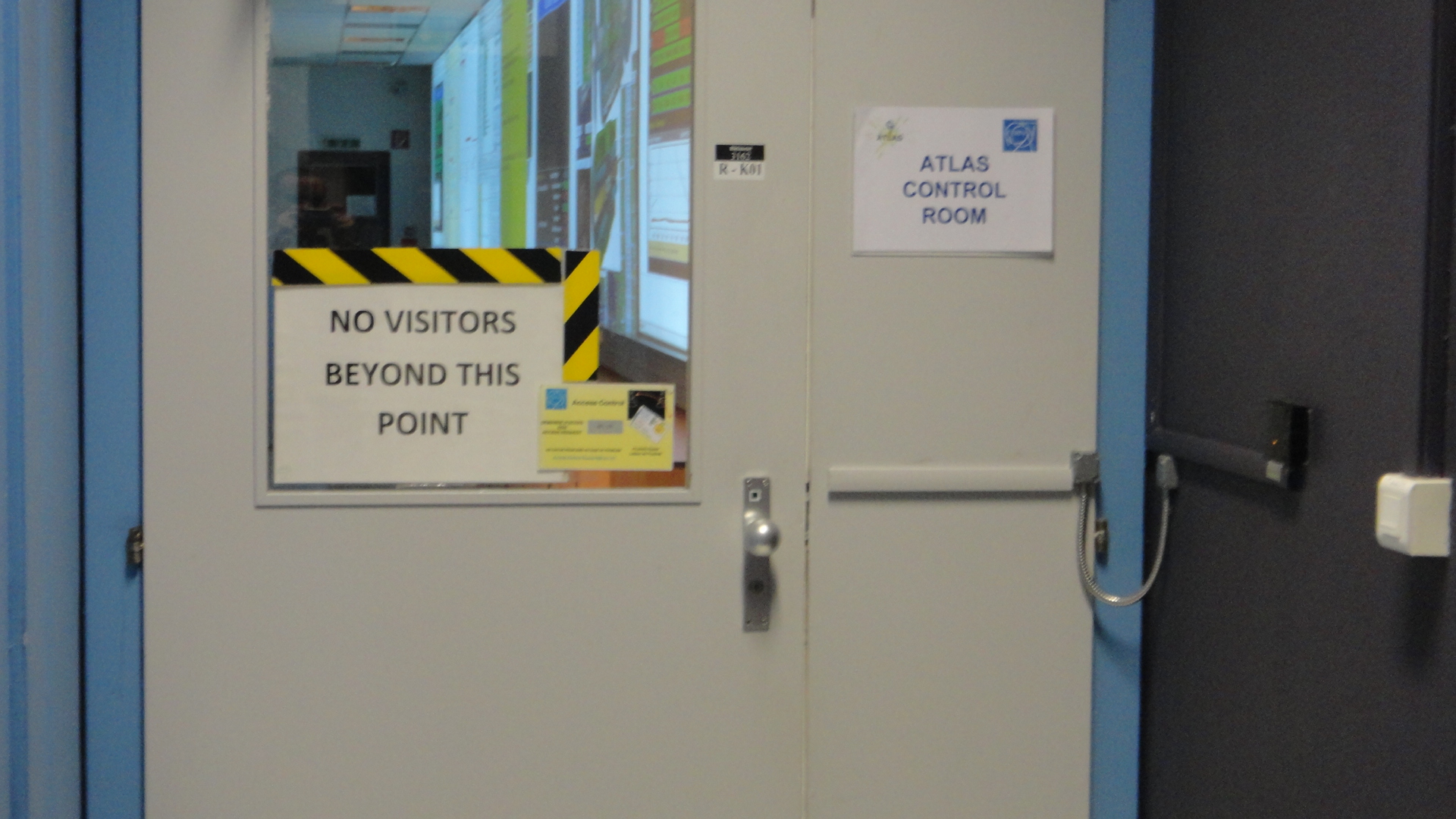
10:30pm: Quiet at CERN. Lots of rain outside. Soon I will go out in the rain as the ATLAS control room is on the other side of the road. Hope my swipe card access still works from last year….
Red Bull Count: 1
Espresso Count: 0

No need for meetings at 10pm on Saturday. Yet.

Artist impression of the particles we brutally lovingly destroy in every collision

CERN at night is like a zombie video game

Essential supplies for any night shifter
11pm: Take over from previous shifter, LHC has cryo problems. Wonder if I’ll even see beam in the next 8 hours. Get in touch with trigger on call expert to confirm she does want to be called when the beams are back even if it’s 4am.

Access granted, the metal gate slides back

Mural by night

Home for the next 8 hours

Previous shifter can’t wait to leave

Phone an expert
11:15pm: Crisis averted. Discovered US->Swiss power adapter left in office with minimal laptop battery remaining, quick dash across the road and all is well again.
Red Bull Count: 1
Espresso Count: 1

Bane of the shift so far

Reminder of why I’m here
11:30pm: When I arrived LHC expected cryo conditions at midnight, this has now changed to 3am 😦

The bad news
12:10am: ATLAS shift leader thinks there’ll be no collisions during this shift, I agree. Not much hope for any exciting updates to follow in this live blog. Less than 7 hours to go, not falling asleep yet!

Thanks Boromir

Me on webcam updating this blog. A picture so meta it could be an episode of Community

Nick Clegg is looking sad because we’re not adding to the 8TeV data for ICHEP tonight
12:50am: Shifter next to me has fallen asleep.
Red Bull Count: 1
Espresso Count: 2

Bank of screens I would be monitoring if there were collisions

Coffee machine. Worshipped as a false God. Giver of life for an offering of 1CHF.
1:15am: A phone rings, it’s not for me.

Super amazing awesome race car toy left by a previous shifter I guess. I may be over selling it a bit.
1:30am: Watching the sector 7-8 temperature curve come back down. Also doing some analysis of 2011 physics data.

Quiz: Given the current rate of temperature decrease, how long before sector 7-8 is back to operating level?

I can’t show any pictures of my 2011 data analysis work so here’s a picture of a low level flying kitten instead.
1:45am: Some activity as a subsystem enters a FATAL state. I won’t name and shame which one but it seems to have woken up a few people in here!
1:50am: The subsystem seems to have got over its hiccup. Not a great 2am wake up call for that on call expert though. Less pressure to fix while there’s no beam, things can become really time critical if there are collisions and data is being lost!
Red Bull Count: 2
Espresso Count: 2
Yawn Count: 2
2:10am: If you did the quiz above you’d have realised 3am was far too optimisitic for cryo conditions to be restored. Looks like LHC page 1 agrees as their estimate has just changed to not before 5am.

More bad news for this shift
2:45am: Starting a yawn count was a bad idea because I’ve already lost count.
3am: Shift half way point 🙂 4 hours to go, LHC sector 7-8 temperature still needs to drop 0.2K before recovery is complete. Current dT/dt is ~0.2K/3hours.

3 hours to go?
3:30am: Midnight(+3.5hrs) snack time.
Do not feed the shifters.

Outside to the hut of vending machines. Too many clouds to see the Supermoon while walking there.

Four vector (kind of)
4:40am: Nothing to report
Red Bull Count: 2
Espresso Count: 3

The ATLAS detector is pretty big you know

The real thing below the surface, waiting
6am: Still waiting, 1 hour of this shift to go
Red Bull Count: 3
Espresso Count: 3

Less red than earlier but still not quite there yet
6:05am: Buses don’t start running to France until 11am on Sunday so it’s a 20 minute walk home for me after the shift.

Yep, I look about as tired as I feel
6:50am: Shift summary posted, next shifter arrived, I’m spent, good night/morning!
ATLAS 2011 Public Results: End of Year Summary
In the summer I started tweeting public results from the ATLAS Collaboration. These come in two formats: @ATLASpapers which are complete analyses submitted to scientific journals for peer review; @ATLASconf which are preliminary results, often a work in progress, where there may still be analysis work needed before journal submission but where the collaboration is satisfied with the robustness of the preliminary result to make it public and allow wider scrutiny.
2011 has been a very busy year for the collaboration. Towards the beginning of the year results were typically analysing the 2010 dataset of ~35/pb; however, since March new data has been flooding in and at the end of the year the total size of the 2011 dataset was almost 150 times the size of the 2010 dataset: ~5/fb! Throughout the year there have been many public results, both preliminary and submitted to journals, on subsets of the 2011 data; the fact that we can generate these results in a short time from a relatively complex experimental setup is testament to the hard work, planning and dedication of the collaboration as a whole. Not to mention hundreds of working group and review committee meetings every week!
ATLAS Papers
In 2011 ATLAS submitted 84 papers to scientific journals of which 58 were based on the 2010 dataset and 26 were based on various subsets of the 2011 dataset. The breakdown by physics topic is as follows:
2010 Data
- Standard Model: 27
- SUSY: 11
- Exotics: 8
- Performance: 5
- B-Physics: 2
- Heavy Ions: 2
- Higgs: 2
- Top: 1
2011 Data
- Exotics: 9
- SUSY: 7
- Higgs: 6
- Standard Model: 2
- B-Physics: 1
- Top: 1
Among these papers five I choose as highlights are:
- Measurement of the Inelastic Proton-Proton Cross-Section at sqrt{s}=7 TeV with the ATLAS Detector – This paper, published in Nature Communications, had the highest ‘impact factor’ of the year.
- Search for a heavy gauge boson decaying to a charged lepton and a neutrino in 1 fb-1 of pp collisions at sqrt(s) = 7 TeV using the ATLAS detector – This paper was the first submitted to a scientific journal using 2011 data.
- Search for the Higgs boson in the H->WW(*)->lvlv decay channel in pp collisions at sqrt{s} = 7 TeV with the ATLAS detector – This paper represents the largest dataset analysed for a paper submitted to a journal on the Higgs boson search in 2011.
- Search for production of resonant states in the photon-jet mass distribution using pp collisions at sqrt(s) = 7 TeV collected by the ATLAS detector – This paper was the 100th submitted to a scientific journal by the ATLAS Collaboration.
- Observation of a new chi_b state in radiative transitions to Upsilon(1S) and Upsilon(2S) at ATLAS – This paper details the first new particle observed by the ATLAS Collaboration, albeit a composite particle predicted by the Standard Model.
ATLAS Conf Notes
In total 163 preliminary results were made public by ATLAS in 2011 of which a full list can be seen here. Although I don’t break them down by physics topic or dataset as above, the obvious highlights in terms of public interest were the Higgs boson searches:
- Combined Standard Model Higgs boson searches with up to 2.3 fb-1 of pp collision data at sqrt{s} = 7 TeV at the LHC – This note combined the ATLAS and CMS datasets using subsets of the 2011 data, this was the first such combination of ATLAS and CMS data.
- Combination of Higgs Boson Searches with up to 4.9 fb-1 of pp Collision Data Taken at sqrt(s)=7 TeV with the ATLAS Experiment at the LHC – This note was released soon after the Higgs boson seminar on December 13th 2011 and represents the best limits to date on the Higgs boson mass from ATLAS. Some of the input analyses use the full 2011 dataset.
So here’s to 2012, hoping it proves to be just as fruitful and that this time next year we can be discussing discoveries!
More Boring Than Advertised?
You would be forgiven for seeing the headlines from EPS-HEP 2011 and thinking the LHC is less interesting than maybe you were led to believe. A year or so ago you might have expected hints of supersymmetry, black holes, extra dimensions or even something more exotic to have been found in the ever increasing LHC datasets. But the current story is that the Standard Model is still describing all data analysed so far pretty damn well. There may or may not be a hint of a Higgs boson but definitely nothing conclusive. Isn’t that a bit boring?
Unsurprisingly I say no, the reason being that unlike this time last year we now know that nature doesn’t look like these exotic models in the data we’ve looked at. The interesting thing is not that nature could be like this or like that, the interesting thing is what nature is really like. We’re doing science after all!
If that’s not enough to convince you then there’s always Lepton Photon 2011 where some LHC analyses might have twice as much data compared to those presented at EPS. In the meantime just try calling the bland sounding Standard Model ‘Super Amazing Gauge Interacting Relativistic Quantum Wavepacket Theory’ or something…
When to believe new physics results
Here’s a brief summary giving my understanding of how physics results are determined in collaborations of hundreds or thousands of physicists such as the experiments at the LHC and when to believe a new physics effect has been seen.
- Someone within the collaboration from an institute (university, lab, etc.) has an idea for an analysis.
- A few people within the institute do some preliminary studies on existing experimental and/or simulated data to see if the analysis is feasible.
- If they decide it is, they make a presentation to a larger working group which manages analyses relevant to the physics of interest. At ATLAS these groups include the Higgs group, the SUSY group and the Standard Model group among others.
- In very large collaborations chances are someone else at another institute wants to study the same analysis, in which case these institutes join together to form a sub-working group for the analysis.
- This is where the bulk of the analysis work is done. The analysis group must convince themselves that their work is robust. They must regularly liaise with the working group and exerts in the reconstruction of the physics objects they are interested in, for example photons.
- All of the analysis work must be fully documented, this becomes the official internal documentation for the analysis and can stretch to hundreds of pages. If anyone requests a cross-check of any kind it must be performed and added to the documentation.
- Once the sub-working group can convince the working group of the quality of their analysis, ie. that it is in a complete form, that relevant cross-checks have been made and that it is fully documented then it can considered for publication.
- A group of around 3 senior people within the collaboration are assigned to the analysis as a publication reviewers. They read the documentation in full. Any further cross-checks required by these reviewers must be performed and documented.
- Together with the reviewers the analysts draft a document for publication.
- The publication draft is circulated to the whole collaboration. A review period of about a week is opened during which time anyone active within the collaboration with access to the internal documentation can request further cross-checks, clarifications, etc. regarding the analysis.
- The publication reviewers work with the analysts in responding to all concerns raised during the collaboration review period. If significant modifications need to be made then the collaboration review repeats as necessary.
- A final draft of the analysis publication is read by another senior member of the collaboration as a final reading. Any remaining concerns must be addressed.
- Once all the above is satisfied the publication paper is submitted to a journal and uploaded on the arXiv server. It has completely satisfied the internal review of the collaboration. Any collaborators not satisfied with the analysis can withdraw their names from the paper.
- The journal assigns the paper to 2-3 external referees who decide whether the analysis is appropriate for the journal and who may require further cross-checks and clarifications to be provided. Generally the referees will not have access to the internal documentation.
- If the referees are satisfied the journal accepts the analysis paper for publication.
This is not an exact recipe and may vary by collaboration but the key message is the same: there are many levels of review which must be satisfied before an analysis represents a final result. It is also worth noting that a result published in a journal which claims a statistical significance below the magic 5 sigma level should be treated with caution until the same collaboration can provide more convincing results with more data or until a rival experiment/collaboration can check their own independent data and confirm the same result. For me only this final point, ie. analyses from independent collaborations which have passed through the above review process BOTH seeing the same new physics effect will convince me that it is there. I emphasise this as the CDF di-jet resonance currently causing excitement does not satisfy this requirement.
As a final comment, the rumours concerning a Higgs signal at ATLAS which have emerged in the last few days represent the content of a note which was written at stage 2 of the above list. It is highly unfortunate that someone within the collaboration thought it necessary to leak the details of an analysis at such an early stage when it is clearly very incomplete.
A full list of submitted publications from the ATLAS experiment is here. I have made an unofficial twitter stream here showing the same information which I update when I remember!
Visiting the ATLAS Detector
This morning I was taken on a tour of the ATLAS cavern, here are some photos of the colossus!
-

- The surface control room.
-

- Mural painted on the ATLAS surface building.
-

- Mural from the side.
-

- The surface entrance eye scanning machine!
-

- The underground entrance.
-

- Access is only allowed during extended shutdowns.
-

- The gold chambers detect muons, the silver bar is the proton beam pipe.
-

- Visible are the toroid magnets and calorimeter endcap.
-

- The red area is where the protons enter the detector just before colliding.
-

- In total around 80 million channels are read out digitally during a collision!
-

- Me next to the detector giving an idea of how giant it really is.
Searching for New Physics
Last week I attended the annual LBNL ATLAS physics group meeting. On the final day some interesting comments were made about the strategy for searching for new physics at ATLAS and with the LHC in general. Here’s a brief summary to the best of my memory…
1. Measure the Standard Model
To find new physics you have to know what you are seeing in your detector. To this end the particles from the Standard Model (W and Z bosons, photons, electrons, etc.) must be well measured. That is to say when you see a photon in the calorimeter you must be confident it is indeed a photon! The best way to do this is measure the Standard Model cross-sections – and who knows while doing so you might see something unexpected! Of course you probably won’t but this relates to the next point…
2. Don’t just set limits
The rate at which the LHC is collecting data means a limit on a particular model can be superceded pretty quickly. In fact the winter conference results on the full 2010 dataset will quickly be overtaken by the initial summer results on 2011 data; however as the LHC energy is extremely likely to be changing (caveat: this decision hasn’t been made yet) a Standard Model cross-section measurement on 2010 data will stand the test of time. Setting limits in a model independent way which also makes a useful Standard Model measurement is preferential. The exception to this rule is the Standard Model Higgs on which limits are well defined and motivated.
3. What to do when new physics is found
The first thing to do when new physics is found is to characterise it. This is not a trivial task and will represent significant work at the LHC if new effects are observed. Another key thing on the discovery of new physics is not to continue looking for alternative exotic models. The new physics is only likely to take one form!
Quantum Mechanics meet Special Relativity
Here as promised is my attempt to explain antiparticles.
First there’s quantum mechanics, the theory of the very small where determinism in the classical sense breaks down; to get anywhere with an experiment you have to predict in terms of probabilities. Probabilities of specific observations must always be between 0 and 1 and the overall probability of observing something must be 1. Then there’s special relativity in which Galilean relativity breaks down as the speed of light turns out to be the same in all reference frames, you may know it predicts E2=(mc2)2+(pc)2 (that’s right I’m leaving the momentum in because it’s correct to; FYI wikipedia rest mass is Lorentz invariant and therefore not the same as energy which isn’t, are you suggesting photons, which have no mass, have no energy?!…)
Now, showing wikipedia is unreliable aside, these theories describe different things: quantum mechanics deals with things which are very small but not moving very fast and special relativity deals with things which are not very small but which are moving very fast (near light speed: relativistic). But what happens if you want to measure something very small but also relativistic as you might in a particle collider like the LHC?
Well you clearly have to find some way of combining quantum mechanics and special relativity. In fact you don’t because British physicist Paul Dirac did exactly that in 1928, you just have to be able to understand how to solve this equation:

Unless you’ve studied quantum mechanics and special relativity the symbols in Dirac’s equation won’t mean much. However, mathematically what it does is satisfy the key requirement of combining the two scenarios: all the probabilities of observing a particle in a given state will be between 0 and 1 and the total probability of observing a particle at all will be 1. Critically this is now true no matter how fast the particle is moving!
Dirac’s equation tells you more than that. If you solve it for a particle like an electron you find there are four solutions. From quantum mechanics we expect two types of electron with the distinction being the quantum mechanical property of spin. Spin is related to the angular momentum of a particle and the two distinct spin states of electrons can be observed by passing them through magnetic fields. The other two solutions are a complete surprise, they predict so called ‘negative-energy solutions’ which can be interpreted as a particle with identical mass and spin states as the electron but opposite charge. This particle, the antiparticle electron or positron, was first seen experimentally in 1933.
Antiparticles represent a profound prediction of theoretical physics later being confirmed by experiment. All of the fundamental particles listed in the table in the previous post have corresponding antiparticles. Also, as mentioned last time, a class of subatomic particle known as mesons, are formed from quark-antiquark pairs. In fact all of the particles formed from quarks have antiparticle partners by exchanging quark for antiquark and vice versa. For example the antiproton is formed of two antiup quarks and one antidown quark.
The Dirac equation as discussed above concerns particles which exist for all time somewhere in space; however, in experiments particles come into and decay out of existence in fractions of a second. The description of such processes requires a more general form of relativistic quantum mechanics: quantum field theory.
The Generation Game
One of the (many) strange and elegant things about the standard model is its generational structure. The matter that makes up everything around us, as any school student will tell you, is formed of protons (p), neutrons (n) and electrons (e). Electrons, as far as we can tell, are fundamental particles; they are not themselves made up of yet smaller particles. The protons and neutrons on the other hand are composite particles each containing quarks, which again we think are fundamental. They contain two flavours types of quark: the up quark (u) and the down quark (d). Protons are made of two ups and one down (p=uud) and neutrons of two downs and one up (n=udd). Interestingly, unlike the electron, you can never see a quark on it’s own due to the nature of the force which attracts one quark to another. They only come in threes like the proton and neutron (you can also get pairs of matter-antimatter quarks together, I’ll explain antimatter in a future post). The only stable combination of these quarks is the proton, all other combinations decay pretty quickly.
So far all well and good, we have three fundamental particles which explain all the visible matter in the universe, except for some unknown reason it doesn’t stop there. Measurements of cosmic rays (the stream of particles which cascade to earth as extra-terrestrial particles collide with particles in the upper atmosphere) and of controlled collisions in laboratories show that there are six more fundamental particles and this is where things get weird. Two of those particles are exactly like the electron only heavier; another two are exactly like the down quark only heavier; the final two are exactly like the up quark only heavier! In order of increasing mass, the electron type particles are the muon (μ) and the tau (τ); the down type particles are the strange quark (s) and the bottom quark (b); the up type particles are the charm quark (c) and the top quark (t). All of these heavier particles decay pretty quickly to combinations of lighter ones as I’ll explain later, but they do exist if only briefly. It makes sense to group the particles in generations as the table shows. You can see that there are three other particles, the neutrinos (ν), which are related to the electron type particles by the weak force, again to be explained later I promise!
But why are there three generations and why is the only difference between them their respective masses? Well that I don’t know, I wish I did!


 Occasional Musings of a Particle Physicist